Decide what to delegate.
Every act of delegation costs something evidential, and the interface never itemizes the bill. The Proficiency Arc traces the movement from procuring output to informed refusal and scheduled reconsideration.
For English language teachers, teacher educators, and the people who train them
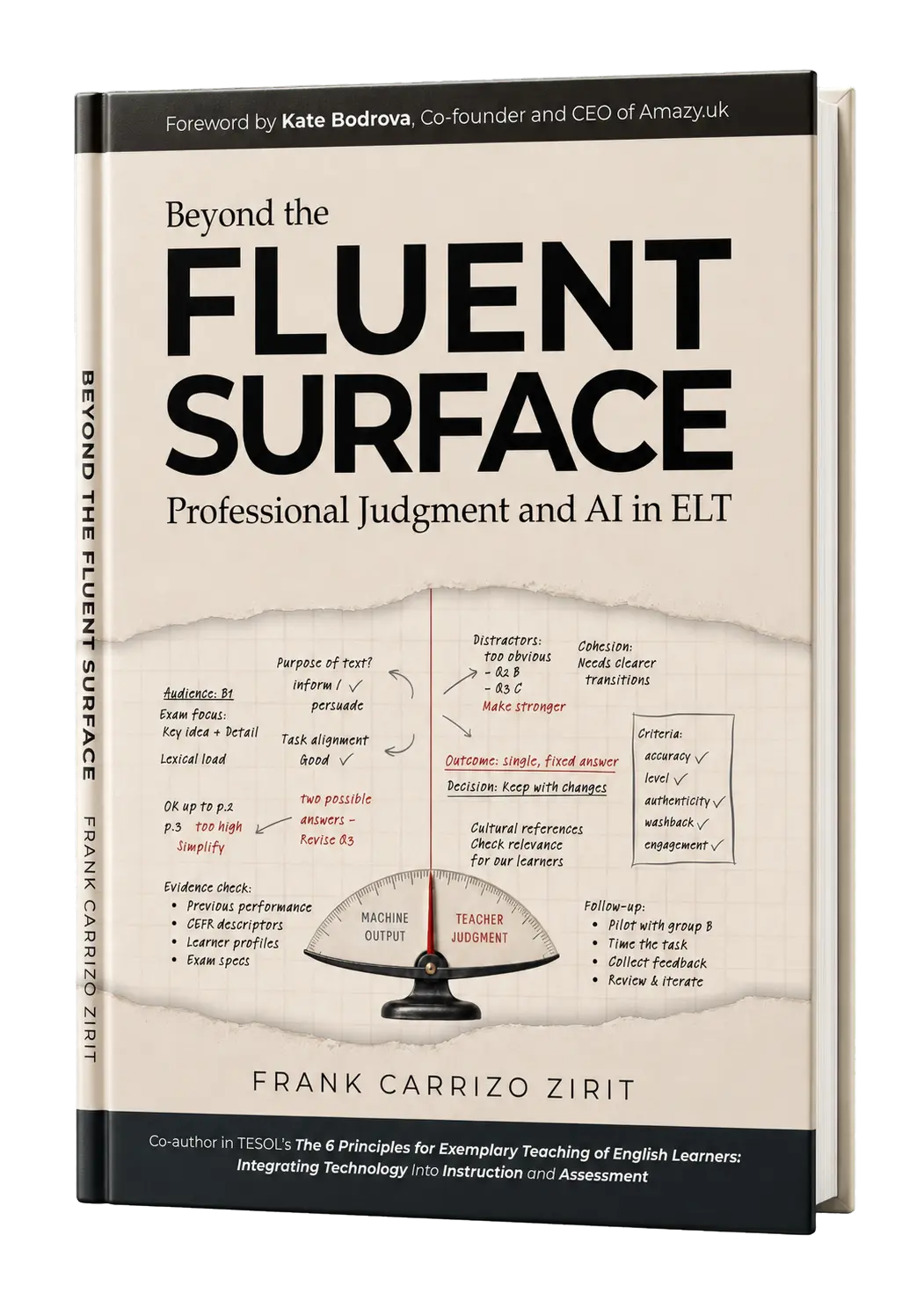
Beyond the Fluent Surface: Professional Judgment and AI in English Language Teaching. A working account of what generated fluency can and cannot evidence, and what a teacher does about it on a Tuesday.
Generative systems have not made fluency worthless. They have severed it from its producer. Treat that as a cheating problem and you will spend the year policing; treat it as an evidence problem and it changes how you assess, design, and protect professional judgment.
The professional question is no longer only “Is this good English?” It is also “What does this English warrant me in concluding?”
Chapter 1, When Fluency Is No Longer Enough01 / The argument
 Machine
The machine can have the sediment.
The scales stay with the teacher.
A working sequence
Behind every chapter is one governing claim: AI can reduce a teacher’s labor while quietly consuming the judgment that makes that labor professionally valuable.
Compression is not abdication, but the two are quite easy to confuse from the inside, and nothing in the interface distinguishes them for you.
Every act of delegation costs something evidential, and the interface never itemizes the bill. The Proficiency Arc traces the movement from procuring output to informed refusal and scheduled reconsideration.
Fluent, plausible, and adequate are three different findings. The CAGE Protocol gives four checks a working teacher can actually run: Cutoff, Admission, Governance, Evidence.
Learner data, protected material, institutional exposure, freelance exposure, and the widening gap between pasting text into a chat window and granting a system the ability to act.
The chapters on deskilling and guardrails deal with the part nobody markets: the work that made you good at this was often the work you would now be glad to hand over.
02 / Terms of engagement
Where the evidence is thin, contradictory, or unavailable, the book says so. Stylistic confidence disguising evidential uncertainty is the failure it spends eleven chapters describing, so committing it would be a very strange way to finish.
03 / Inside the book
Four parts. Eleven chapters. A glossary, full references, and a note on how AI was used in the making of the book.
Why fluent output is insufficient rather than worthless, and why ELT faces a distinctive evidence problem.
Separating measured findings from extrapolation, historical hype, product claims, and professional inference.
From output procurement to specification, evaluation, informed refusal, and scheduled reconsideration.
“Back to the teacher at the kitchen table, and one changed decision.”
04 / The reader
You are already using these systems, or already refusing to, and in both cases without much to reason from. The decision has to be defensible on Monday. It also has to be cheap enough to survive your actual week.
You are being asked to teach AI literacy before the field has agreed what it consists of. This book separates operating a system from diagnosing what its output warrants.
You are writing policy that will be read as permission or prohibition, and neither is what you mean. Start with the chapters on assessment, the perimeter, and guardrails.

06 / Method
Beyond the Fluent Surface carries a full account of how AI was used to research, brief, audit, and draft it, with the boundaries stated and the limits named. A book that asks teachers to interrogate their tools has no standing to be vague about its own.
07 / Early readers
“A beautifully grounded and essential read...”Erdeşin Doğu, ESL Instructor & Children's Book Author
“The distinction ... between maintaining an existing skill and having the opportunity to form it in the first place was one of the strongest parts of the book for me.”Raffaella Manzo, Teacher Trainer and Founder of ProTEFL Institute
“...teachers are capable of judgment. [This book] gives them structured frameworks to exercise that judgment, and then takes seriously the possibility that the conditions of their work might erode that.”Ruairi Braddell, ELT Editor

Kate Bodrova
Founder and CEO, AMAZY
08 / The Foreword
Kate Bodrova is the founder and CEO of AMAZY. She spent ten years in the classroom before founding it, and built the platform she wished she'd had: an AI-powered space for creating interactive lessons, sharing materials, assigning work to students and tracking their progress over time. AMAZY was named Best EdTech Startup in Europe at EdTechX 2024 and has been supported by UCL EdTech Labs and the UCL Centre for Digital Innovation. She lives in Brighton, UK.
09 / Opening the book
A personal account of relief, scrutiny, and the work that formed the book’s central question.
10 / Continue the work
The companion CPD strand translates the book's professional checks into adaptable trainer-led sessions. It includes a master guide, session materials, trainer notes, and a clear account of the constraints that keep the work focused on judgment rather than tool training.
Access is password protected. The password appears in every edition of the book.
Access the CPD materials11 / Press and media
Complimentary eBook review copies are available to journalists, editors, reviewers, and contributors to public outlets who are considering independent editorial coverage.
Requests are considered individually. Approved applicants receive an eBook review copy, not for sale or redistribution. The copy is offered for independent consideration and does not require a positive review, because obviously we have not set up a tiny praise hostage situation here.
Show the outlet
Include its URL and a byline, profile, or example of your previous work.
State the plan
Tell me the editorial angle and likely publication timeframe.
Receive a decision
Approved applicants receive a complimentary eBook review copy.
Review-copy request
Please provide enough information to establish the outlet and your connection to it. Requests are reviewed individually.
Beyond the Fluent Surface
The paperback and eBook are now available from Lulu, the book's chosen imprint. Buying there is the most direct way to receive the book and support this independent publication. Other retailer links will be added as they become available.